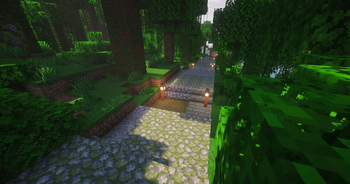
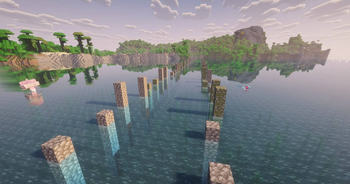
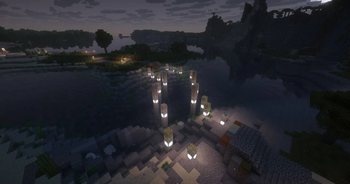
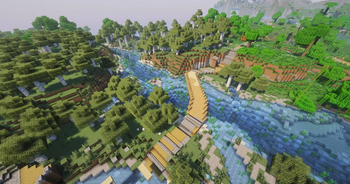
Physical roads generated in world-gen that connect your world's structures - named routes, towns and areas, with waypoints and full Xaero map integration.
Your world has towns. It should have roads between them.
Routes builds a real road network during world generation — physical, signposted, named and lit —
running from one settlement to the next across whatever terrain is in the way. It bridges rivers,
bores tunnels through mountains and lays paved channels across open water, so the map between two
towns stops being a gap you cross and becomes a place you travel.
Works on a plain Minecraft world, and picks up the towns your modpack adds without being told.
✨ What you get
🛣️ A road network that plans around the ground — terrain-aware pathfinding lays 3–5 block
roads, built incrementally as you explore and picked up again after a restart.
🏘️ You choose what counts as a town — a checklist built from the structures your world
actually has, grouped by the mod each one came from. Villages by default; your pack's own
settlements are right there in the list.
🌉 Bridges, tunnels and water crossings — a river gets a deck, a mountain gets a bore with
lanterns in it, and open water gets a swimmable channel with a paved, lit bed and marker rocks
down both sides of the lane.
🪧 Every road has a name and says so — Route 3: Steep Pass on the signposts and the map
(the descriptive half is a setting), junction signs where roads meet, and a welcome board on the
way into town.
🔵 Loops enclose named areas — as the network closes rings between nearby towns, the ground
they surround becomes a numbered, named region (A3-Frostpine; the name is a setting).
🔦 Each road has its own look — surface material and lighting are decided per route, so most
are lit and the occasional dark one keeps exploring spooky. All of it overridable.
⛺ Somewhere to stop — campfire camps along the longer stretches, with supplies.
🏙️ You start in a town — world spawn moves to a real settlement, already on the network.
All of it is configurable — per world when you create it, and in game once you are in it, in
English and Spanish.
🗺️ Map integration (optional)
With Xaero's Minimap
(CurseForge),
Xaero's World Map
(CurseForge) or
JourneyMap
(CurseForge) installed, towns,
roads and areas each get their own waypoints in their own filterable sets, and an optional layer
tints every chunk by what it is — towns, roads, and the areas that only paint once your roads truly
enclose them. The colours are yours to pick, and every map shows the same thing.
New worlds generate a circle of ground around spawn, so the map opens on towns and roads instead of
an empty grid.
With Waystones installed, activating a waystone puts it on the network as a named town.
🧩 Requirements
Minecraft 1.21.1 · Fabric or NeoForge · Java 21
Fabric: Fabric API + Architectury API + Cloth Config.
NeoForge: Architectury API + Cloth Config.
Cobblemon is not required. Routes declares no Cobblemon dependency of any kind. It does pair
with it: with Cobblemon installed the towns take their names from the mainline regions, and with
Cobblemon Picnic
(CurseForge) installed some rest stops come up as
picnic tables instead of camps. Without either, nothing is missing.
📖 Everything else
Settings, commands and the full feature reference live on the
wiki.
Found a bug or have an idea? The Discord picks reports up
automatically and replies in your thread when the fix ships.
The mod is free and stays free — you can
sponsor the author if it made your world worth
walking across.
License:"If you make money, I make money" — free to use and redistribute for free; commercial
use needs a revenue-sharing agreement. Videos, streams and reviews are always free, monetized or
not. Full terms.
A second beta of Routes 2.0: roads are planned in a fraction of the time, a reopened world remembers its towns and roads, and the land around a new spawn gets its roads. 🧪
> ⚠️ **This is a beta.** It has not had its full in-game test pass yet. Back up your world before you
> update, and tell us on Discord or GitHub if anything looks wrong.
### ⚠️ Changed
- **The settings that shape the road network are fixed for each world.** Changing one mid-world (the longest
road, roads per town, town and city sizes, ring roads, curviness, slope, road width, straight bridges, which
structures get connected, or the landmark settings) gave the land generated afterwards a second network whose
roads stopped short of the old ones. A world now keeps the values it was created with: `/routes config set`
saves the new value for the worlds you create next and says so, and `/routes config list` marks these
settings. A world you already have keeps the values it uses today.
- **New worlds pregenerate 512 chunks around spawn by default, down from 1024**: enough for the spawn town and
its first road out, in about two thirds of the time. Worlds you already have keep their value.
- **"Generate routes" off means no roads planned ahead and no spawn moved into a town.** The spawn stays where
the game puts it, and creating the world skips the town search.
### 🚀 Faster worlds
- **A reopened world remembers its towns and its roads.** The town survey and the plan of every road
already drawn are saved inside the world and read back as it opens, so reopening no longer pays for
them again. Both are thrown away and rebuilt on their own when a mod, a datapack or the world's road settings
change; deleting the files only costs time.
- **Roads are planned much sooner.** Landmarks along the way are looked up once and several at a time,
the towns at a road's ends are sized while the road is planned, and the ground under it is read on
several threads at once. On a test walk through new land, roads finished planning in about half the
time. The roads are exactly the same.
- **Finding the towns of a new area is faster.** A town is confirmed from its first building and laid out in
full only when a road depends on its size or its edge.
- **Routes looks for towns only where you are about to go**, not in a wide square around every player.
- **Shaping the ground under a road takes over a thousand times less work per road chunk**, and the ground
comes out the same, block for block.
- **Background road work no longer piles up or waits on itself.** Each survey or plan is queued once,
and a town search that another mod makes fail is not repeated by every chunk around it.
- **Work Routes used to repeat is now done once**: which structures count as towns and landmarks, where
two roads cross, whether each fork stands on solid footing, and whether a tree would stand on a
road, which no longer gets slower as the world grows.
- **The zone banner no longer gets slower with every area you discover.**
- **New road paint lands on your map without redoing the whole map**: about half a millisecond per update on a
map with 50,000 painted chunks, down from 12 ms with spikes past 30.
- **The server keeps its road map in a quarter of the memory**, and long sessions forget only the oldest ground
heights instead of measuring everything again.
- **Walking along a numbered route no longer re-queues all of its signs**: they are written once, when the
route gets its number.
### 🐛 Fixes
- **Roads, signs and terrain shaping reach the land around a new world's spawn.** The chunks Minecraft
generates before the world opens were made before Routes was ready, so a road crossing them stopped at their
edge and started again on the other side.
- **A dedicated server pregenerates a new world's spawn from the first join**, using its own config file,
instead of waiting for an operator to run `/routes config set`.
- **A road between far-apart towns no longer stops in the middle of nowhere** where a long chain of towns was
linked two different ways. Worlds you already have keep their roads.
- **Cancelling Create New World no longer leaves its ROUTES choices behind** for the next world or server you
open.
- **Your world's road map file saves the same way every time**, so backups stop seeing a new
`routes_gen2_map.dat` on every save.
### 🔧 For server owners
- **The road network is now tested automatically across twenty worlds**, including worlds whose towns sit far
apart.
- **Each planned road logs what its time went to**, and the headless benchmark times the town survey in
parts and runs a first join's spawn pregeneration with nobody joining.
- **A leftover manual Discord workflow is gone**, and with it one more copy of the bot's key.
A beta of Routes 2.0: new worlds open much sooner, nothing stalls the server while land is being built, and the old road generator is retired. 🧪
> ⚠️ **This is a beta.** It has not had its full in-game test pass yet. Back up your world before you
> update, and tell us on Discord or GitHub if anything looks wrong.
### ⚠️ Breaking
- **The classic road generator is gone.** A world made with it is frozen: it loads and plays as before,
keeps every road, its map paint, zone banners and Nuzlocke zones, and never grows a new road. It is never
converted, never gets the new roads laid over its own, and no longer pre-generates its spawn. The
**Native route generation** switch is removed.
- **Eight commands that only worked on frozen worlds** (`scan`, `connect`, `addcity`, `delcity`, `weave`,
`repaint`, `reset`, `debug structures`) now answer with one line that names their replacement, if there is
one.
- **`/cobblemonroutes` is gone; `/routes` is the only command.** Update command blocks and macros.
- Add-ons built for an older Routes keep working: the safe-landing and ground-height lookups they use stay
as deprecated forwards until the next major.
### 🚀 Faster worlds
- **The land around your spawn is ready when you arrive.** Routes surveys the towns around your spawn on the
loading screen (*Routes: surveying the towns around your spawn*), once per world, so the chunks around you
load four to five times faster after you join.
- **With *spawn in city* on, your town is no longer built before the world opens.** In the automatic speed
test the wait went from 139–364 s to 60–103 s. You still wake up in the town.
- **Spawn pregeneration generates what it promises**, and its progress bar moves at the pace of the work;
the chunks of the road ahead are pre-loaded the same way. A new singleplayer world pregenerates its
spawn even if you never open the ROUTES tab.
- **Towns are found faster**: the village checks run side by side and find exactly the same towns.
- The *spawn in a city* step gives up after three starts instead of freezing the server on every one.
### 🐛 Fixes
- **No more stutters while a new world is being built.** Road signs, map markers and the zone
banner made the whole server wait for land still being generated. They now wait their turn in the
background, and signs that were left blank get their text as soon as their ground loads.
- **Joining a server with a huge road map no longer disconnects you.**
- **Creating a world after leaving another one no longer crashes** with *Failed to load registries*.
- **Another mod's world generator failing no longer stops your world from opening**: Routes skips the town
spawn and names the error in the log.
- **Two kinds of settlement can no longer swap towns** when they are looked up at the same moment.
- **Route markers and a route's first signs stand where the road leaves town**, on the real surface, and
stay there after you rejoin.
- **The loading-screen road waits for your spawn**, held just short of full with *Routes: placing your
spawn* and a running count of seconds.
- Tunnels are carved clear through ore and dripstone, tunnel lighting follows its setting, and
signposts keep their posts where two roads overlap.
- `/routes config set` refuses a value it does not know, and Mod Menu names every Routes setting, in
English and Spanish.
### ✨ New
- **Descriptive names are back**: *Route 3: Steep Pass* on signposts, waypoints and the zone banner,
and *A3-Frostpine* for enclosed areas. Each has a setting to turn it off, and applies to roads and
areas numbered from now on.
- **JourneyMap support**: the same chunk paint and waypoints you get on Xaero's maps.
- **Routes ships its own list of towns, landmarks and structures to ignore**, so a pack like the Cobblemon
Official Modpack gets roads to its gym entrances with no config, and a data pack can extend it.
- **`/routes rename`** renames a town, signs and welcome board included.
- **`/routes status`, `list`, `nearest`, `zone` and `tp` work on the new roads**, showing what you have
discovered.
### 🔧 For server owners
- New read-only diagnostics: `/routes debug workers`, `/routes debug bore`, `/routes debug
forks`, and a *no town in common* line in `/routes debug edges`.
- Failures that used to vanish while building roads are now logged and counted.
- Every change to Routes is now built for both loaders and tested automatically, and a
headless speed test, a road fingerprint and a road-quality audit catch a version
that moves or worsens your roads before it ships.
Landmarks, towns of every size, a map you set by command, and roads that look laid. 🗺️
### Towns, landmarks and the network
- **Settlements come in three sizes, village, town and city, and bigger ones carry more roads.** With
the default of four, a village gets one or two roads, a town two or three, a city three or four, and
no town is left unreachable. New options on the ROUTES tab: **Bigger towns, more roads**, **Town
size** and **City size**; `/routes debug settlements` shows how the towns around you fall into the
three. It changes which roads exist, so it applies to worlds created from this version on.
- **Every structure is a settlement, a landmark or ignored.** The create-world checklist is now **Towns
& landmarks**: every row reads Settlement, Landmark or Ignored, starts on the automatic answer, and
cycles with a click. `/routes structures` groups its file the same way. Unticking Villages now
really keeps them off the network, and the Fossils row, which connected nothing on Cobblemon
1.8, is gone.
- **Roads respect landmarks.** A road steers around a landmark instead of cutting through it, bends a
little to pass beside the one nearest its way, and a signpost on the landmark's side says what it is,
in English or Spanish; a structure from another mod is named from its id. New options: **Roads go
around landmarks**, **Landmark pull** (0 to 10, default 3), **Landmark reach** (default 96 blocks) and
**Landmark signs**. They apply to worlds created with this version and to ground not generated yet.
- **Roads wander a quarter less** at every Route curviness setting; the setting itself means what it
always meant.
- **For add-on authors:** rest stops, signposts and junction plazas respect an add-on's keep-out claim,
as roads already did. An add-on can ask where a water crossing's marker rocks stand and
whether a point on a road is a bridge deck.
### Managing the network
- **New command: `/routes remove`** (operator) takes away the town or the road you are standing on, and
names the road it withdrew. Where two roads cross your chunk it lists them and removes nothing.
**`/routes settlement reconnect`** puts a withdrawn road back.
- **`/routes settlement disconnect` works on generated roads**, so one road can go without deleting a
town. **`/routes settlement restore`** brings back a town you removed, with its name and roads,
and **`/routes delcity`** removes the town next to you, telling you which one and how far away
it was.
- As with every removal, ground that has already generated keeps its road; only new chunks change.
### On the road
- **The road surface comes in patches**, like laid paving, instead of changing at every block,
and the things along a road (marker rocks, channel floors, signposts, junctions) keep one kind over a
stretch instead of cycling at every step.
- **Tunnels are 9 wide and 8 tall by default**, with new **Tunnel width** and **Tunnel height** options.
A tunnel that crosses a cavern has walls, not just a roof, and its lanterns only hang
where there is rock to hang them from.
- **A bridge over water runs straight from bank to bank**, with a new **Straight bridges** option, on by
default. A short stream crossing keeps its deck instead of leaving a hole in the road.
- **Roads meet the water at the shore's own height.** The ramp that used to be dug into the bank is gone,
and a road steps onto a swimmable crossing at the water's level. Bridges keep their
ramps.
- **Water crossings can be followed at night**: each marker stone stands on a short pillar of the same
stone, with a sea lantern under it on a lit crossing. A signpost at a water crossing is always
a board on a post, never a sign hanging over the water.
- **Every real drop of two blocks or more gets a ladder**, measured on the road as it is built.
- **Rest stops fit the ground they stand on.** A campfire stop's cleared patch matches the place:
trodden podzol on grass, the ground itself on sand, gravel or snow. A picnic-table stop stands
on the grass itself, and its bread is in the table, with no basket beside it.
### The map
- **Xaero's world map is Xaero's own again.** The Routes panel drawn over it is gone, and with it
the on-demand Load chunks feature. The head start around spawn in a new world stays.
- **`/routesmap` opens a small screen with every map setting**: the chunk paint toggle, the waypoint
grouping, and an intensity and a colour for towns, roads and areas, applied as you change them. Its
subcommands do the same from chat, and `/routesmap list` prints a summary. It needs no operator
rights and works on any server. Turning the paint off and on is instant.
- **A key shows and hides the chunk paint.** Bind **Show / hide chunk paint** under **Routes** in
Controls; it ships unbound.
- **A road reads as one band about three chunks wide** on the map. Zone commands repaint the
minimap right away, not only the world map. With waypoints grouped per category, the
Settlements set is selected on your first join, so the markers show without hunting for them.
- **The map draws faster.** Working out a chunk's colour is about five times faster and allocates
nothing, and panning over wild country far from any road is up to twenty times faster.
### Fixes and housekeeping
- **Spawn is no longer moved onto a rock in the open sea** when every town nearby is underwater.
- **Routes refuses to install on a Minecraft version other than 1.21.1**, instead of crashing on
1.21.11.
- **The store page is rewritten**: no deleted buttons, no stale roadmap, and it says plainly that
Cobblemon is not required.
- The license inside the jar names all seven mods, and the development build only deploys to
test profiles that exist.
A map that builds the world, a settings screen you can read, roads that meet the water where the water is, signposts that only name real towns, and roads that keep up with a big load. 🗺️
- **The world map can now generate the ground around you, and tell you what that costs first.** Choose
how many chunks with a slider, press Load chunks, and a confirmation says how many will be generated
and roughly how long it takes before anything starts. The job runs in the background — the map fills
in as it goes, a counter tracks it, and the same button becomes Cancel until it finishes. On a
server, starting one is an operator's call; in your own world it is yours. (#67)
- **The Repaint map button is gone.** It re-drew the map by hand, and the one moment that is genuinely
needed — fresh ground having just appeared — now happens on its own the instant a chunk load
finishes. (#67)
- **The ROUTES tab at world creation is split into sections.** Every setting sat in one list under a
single heading, twenty-six deep, so finding the one you wanted meant reading all of them. They are
grouped now — Route Generation, Towns & Settlements, Road Shape, Surface & Lighting, World Spawn,
Map & Notifications — in the order you meet them, and the in-game settings screen follows the same
grouping. Nothing was renamed and nothing changed value: the worlds and the config file you already
have are untouched. (#69)
- **With Cobblemon Picnic installed, some rest stops are picnic tables.** About a third of the camps
along a road come up as one of its basic picnic tables instead, with a basket of bread standing
beside it — so a stop is somewhere you can actually sit down and picnic, not only somewhere to warm
your hands. The rest are the campfire camps they have always been. Without Cobblemon Picnic nothing
changes at all: every stop is a camp, and no imitation table is ever built out of ordinary blocks.
Stops on roads that have already generated stay as they are. (#143)
- **A road coming out of the water no longer climbs a mound to do it.** Where a swimmable crossing met
the shore, the ground either side of it was built up — sometimes a long way up — into a bank the road
then had to come back down. It was the crossing's own bed pulling the shoreline up to meet it. The
road follows the ground down to the waterline instead, and where the shore is already low it simply
stays low. Bridges are untouched: a bridge approach still climbs to its deck and still meets it in a
single step. (#169)
- **A road is numbered the moment it is built, not the moment you walk it.** Route numbers were handed
out on arrival, so a road you could see from a hilltop — or one you crossed halfway along, without
ever reaching either end — was nameless, and its fingerposts could only point at two towns. Roads are
numbered as the world draws them now, so every road that exists has a number and its signs read it
from the first one you meet. Numbers stay short and sequential; the order they run in is the order
the world built them. Worlds you already have keep every number they handed out. (#171)
- **A fingerpost no longer points at a town that does not exist.** Where a road forks, the sign has to
follow the road past the junction to find the settlement it really leads to — and where it could not
see that far, it named the junction instead. A junction is a piece of road with nothing on it, so
what went on the sign was an invented place. That line is simply left out now: a signpost gives you
the road you are standing on and whichever end of it can honestly be named. (#150)
- **A big chunk-loading job no longer leaves the roads inside it building from scratch.** While the
game was generating ground for you — the map's Load chunks button, or the ground laid down around a
new world's spawn — the mod stopped looking ahead at the roads in that ground **entirely**, so every
road chunk the job touched had to work its road out at the moment it was needed, which is the one
moment that makes you wait for it. It looks ahead throughout now. The job itself is unchanged and
costs the same; the road chunks inside it stop being the slow ones. (#150)
- **Waystones now work on NeoForge.** Activating a waystone names it after the town Routes knows for
that spot, registers it on the road network and moves the town's map marker onto the waystone
itself — all of which Fabric has always done and NeoForge silently did not, because the
integration was only ever wired up on one of the two loaders. Nothing changes for anyone without
Waystones installed. (#177)
- **An operator can author a zone over a whole region now, and manage it by name.** Deciding what a
patch of ground counts as — a town, a road, an area, or nothing at all — meant standing on every
chunk of it, one at a time. A zone can be drawn as a box between two corners, given a name, and
then grown, shrunk, renamed or removed as one thing. Ground that already belongs somewhere else
is still refused unless you say otherwise, and the refusal names what it would have taken:
moving a chunk from one zone to another changes which zone a catch already made in it belongs
to, so it is never done by accident. (#164)
- **The Laburo: draw a zone by clicking its two corners.** A red-bladed shovel for map makers, in
the Tools tab of the creative inventory. Right-click one corner, right-click the opposite one,
and the ground between them becomes a zone with a name you can rename afterwards; sneak and
right-click to choose what it becomes — a town, a road, or nothing at all. Right-click the air
if you change your mind about a corner. **It has no recipe**: it does nothing without operator
permission, so putting it on a crafting table would only teach a survival player that it is
broken. It never takes ground that already belongs somewhere else — it tells you what stood in
the way and leaves that decision to the command. (#164)
- **Close a ring of road and the land it encloses becomes an area, there and then.** An area is
never something you draw — it is the space left between the roads — so one only ever appeared
when somebody happened to walk into it. Now the moment an authoring edit closes a pocket, that
pocket is named and marked, and whoever drew it is told how many appeared. Areas that close
the ordinary way, as the world generates roads, are unchanged. (#164)
- **`/routes debug areas` agreed with nothing once you started authoring zones.** It was reading
the generator's own paint and ignoring the zones an operator had authored on top, so it
contradicted the map, the zone banner and the capture zones — precisely when you would run it
to find out why they disagreed. (#164)
- **A zone you author now gets a marker on the map.** It painted the ground and dropped no pin,
ever. A town's or a road's marker takes its name from the road network the world generated, and
a zone you drew by hand is not in it — so there was no name to give and nothing appeared. An
authored zone is announced under its own name instead, and comes back under it every time you
rejoin. (#164)
- **A ring drawn in country the generator has not touched yet closes an area properly.** The check
gave up early whenever no road had been generated anywhere, which is exactly the state a fresh
map-making world is in. (#164)
- **A world keeps the road-network rules it was made with.** Improvements to how the network is
planned — which towns connect, how a road is traced — cannot simply arrive in a world already
half-explored: the ground you have walked was built by the old rules and the ground ahead would
be built by the new ones, leaving roads that stop dead at the join. Every world now records
which generation of the rules it was born with and keeps it. Nothing generates differently yet
— this is the door the coming changes go through, and `/routes debug settlements` says which
generation your world is on. (#164)
- **A town no longer sends several roads off in almost the same direction.** Where six neighbours
sat in one quarter of the compass, six near-parallel roads left the town for them, and each one
costs the world real time to plan. A road that would set off within thirty degrees of one
already leaving is dropped, and the shorter of the two is the one that stays. **New worlds
only** — a world already under way keeps the network rules it was made with, so nothing you
have explored changes shape. (#175)
- **Roads are worked out in two passes instead of one, so exploring costs the machine less.** The
mod used to search the whole stretch of country between two towns at full detail to find one
road through it. It now sketches the route roughly first — cheaply, over the same ground at a
quarter of the detail — and then does the careful work only in the narrow band around that
sketch. If the sketch finds nothing, the old full search runs exactly as before, so a road that
exists today still exists. **New worlds only.** (#172)
- **Two villages close enough to touch are one town.** Where two settlements generated almost on top
of each other — which happens where a modded village lands on the same ground as a vanilla one —
the mod saw two towns and ran a road between them. That road began in a village and ended in the
same village: it had a number, a place on the map and signposts pointing along it, and walking it
took you nowhere. Settlements that close are read as one town with one name now, so the road
between them never exists, and that is one fewer road for the game to work out. **New worlds
only** — a world already under way keeps the network rules it was made with, so nothing you have
explored changes shape. (#170)
- **A step in the road is the same step from either side.** A one-block rise was dressed as a
staircase using the direction the road was travelling, so a climb and a descent were two different
sums — and for a long stretch only one of them was right, which is why the same slope came out a
proper staircase walked one way and a staircase sunk a block walked the other. A step is read off
the ground around it now: a block with one neighbour a block lower, and no drop on its other side,
carries the stair, and the stair faces uphill. The answer is the same whichever way you walk, and on
a road running diagonally the stairs land on the columns where the step actually is instead of
straight across the width. Roads already generated are unchanged. (#173, #106)
- **A tree no longer grows in the middle of the road.** A tree that landed on a road was built and
then torn out again — trunk, then crown, then whatever was left hanging — and every kind of growth
the clearing did not know about became its own report: a canopy floating over the road, bamboo
through the paving, a giant mushroom on the verge. Growth that would start on a road is simply not
planted now — trees, bamboo, giant mushrooms and ground cover ask the road first. The clearing stays
for everything else and for the roads you already have, so nothing already generated changes.
(#174, #113)
- **Wraith Waystones now works like Waystones does.** Discovering one of its waystones names it after
the town Routes knows for that spot and drops the town's marker on your map — the same single pin
that walking into the town would have given you, not a second one beside it. Fabric only, because
that is the only loader Wraith Waystones ships for; the original Waystones is unchanged and a pack
can run either, both or neither. (#81)
- **A road no longer has a step running along its own width.** Where a road ran diagonally, one half
of it could sit a block higher than the other for a stretch — a low kerb down the middle of the
carriageway, dressed in stairs that looked like they had been put there for no reason. The height of
the road is measured along its length now and is flat across it, so the whole width of the road is
one surface and a step only ever happens where the road is actually climbing. The stairs that were
covering those kerbs are gone with them. Roads already generated are unchanged. (#178)
Roads that arrive properly: staircases with a way out, shorelines that stay near the water, and towns
whose names come from every region. 🛣️
- **Staircases lead somewhere.** A road climbing into a bank used to lay its steps straight into the
hillside and stop — three stairs facing a wall of dirt. The doorway at the top is cut now.
- **Roads meet a town at the town's own level.** The last stretch into a settlement used to trace
whatever ground was under it and give up the moment it disagreed by more than two blocks, which left a
step at the gate — worst of all where the road arrived from a tunnel. It grades between the two ends
now, cutting and filling to arrive level with the street.
- **Coming out of the water is gentler.** A crossing used to rear up onto its bank at full tilt and read
as a mound; the climb is spread over twice the distance and hugs the waterline for longer.
- **Water crossings are marked on both sides.** A stone that fell in the next chunk over was quietly
dropped and nobody ever placed it, so diagonal crossings came out marked down one side only.
- **Every settlement decides how many roads it wants**, between one and four, instead of the whole world
sharing one number. Hamlets with a single way out, crossroads towns with four.
- **Town names from every region.** With Cobblemon installed the pool covers Kanto through Paldea
instead of three regions.
- **Signposts sit at the right height.** Hanging signs hang above head height instead of in your face;
boards read at eye level instead of over your head. Lamp posts are one block tall, not three.
- **Roadside camps have no lamp** — the campfire is the light — and the chest that sometimes stands
beside one is now genuinely rare, and no longer announces itself to Lootr.
- **Roads break the plants in their way**, including cocoa, apricorns and wildflowers, instead of
treating them as somebody's build and stopping. Farm crops are still left alone.
- **The load says what it is doing.** Surveying, graphing, planning or drawing, with counts and timings —
it was written for the loading screen years ago and read by nobody.
### Everything else since 1.1.6
Routes was rebuilt around Minecraft's own world generation in the meantime, and forty versions of
it went by without a release. The short of each, newest first — the full detail is in `CHANGELOG.md`
in the repository:
- **1.2.44** — Somebody left a chest at the campfire. 🧰
- **1.2.43** — Bridges are built out of the wood that grows where they stand, their steps meet the bank instead of starting a block above it, and stairs turn corners properly on a chunk seam. 🌉
- **1.2.42** — Nothing changes for a player. Under the hood, the settlement survey can now be asked its question from inside world generation, which is what lets an add-on generate a structure at a spot the road network decides — the Elite Four, in Cobblemon Nuzlocke & Soul Link. 🔧
- **1.2.41** — The town marker sits ON the waystone. 📍
- **1.2.40** — Junctions that stand somewhere, bridges you can climb onto, and trees taken whole. 🌉
- **1.2.39** — Groundwork for add-ons that change world rules in play. ⚙️
- **1.2.38** — Towns that are really there. 🏘️
- **1.2.37** — Towns say hello. 🪧
- **1.2.36** — Town markers sit on the waystone. 📍
- **1.2.35** — Stone railings. 🧱
- **1.2.34** — The "Cities include" checklist finally works both ways. 🏘️
- **1.2.33** — The End stops counting as a town, and the lights calm down. 🏘️
- **1.2.32** — Roads that get built at all, and a generator that stops asking the same question twice. ⚡
- **1.2.31** — Steps you can actually walk, ladders where a step will not do, and towns that announce themselves again. 🪜
- **1.2.30** — Junctions you can walk through, roads that climb, and towns you arrive at instead of through. 🛤️
- **1.2.29** — Signposts you can read from the road, and towns you can name. 🪧
- **1.2.27** — The world closes. 🪧
- **1.2.26** — `/routes settlement connect` completes the coordinates for you. 🏘️
- **1.2.25** — A road you can find on the map, and one that stops leaving things in the air. 🗺️
- **1.2.24** — Put a town where you want one. 🏘️
- **1.2.23** — Roads join a village where its streets already end. 🛤️
- **1.2.22** — The mod's markers arrive in one place, and it is the place you are looking at. 📍
- **1.2.21** — Both sides of a signpost point the same way. 🪧
- **1.2.20** — Counting the road network instead of guessing at it. 🔍
- **1.2.19** — Exploring stops costing what it did. 🗺️
- **1.2.18** — A crossing stays a crossing, and nothing balances on a step. 🌉
- **1.2.17** — Walking down a hill is the same staircase as walking up it. 🪜
- **1.2.16** — The bridge audit says what it found, not just what it missed. 🔎
- **1.2.15** — A road stops mistaking its own steps for someone else's wall. 🪨
- **1.2.14** — Roads you can see, staircases that turn, and a bridge that can be inspected. 🌉
- **1.2.13** — The survey stops being redone from scratch. 🗺️
- **1.2.8** — One signpost, built out of the forest it stands in. 🪧
- **1.2.7** — Generating a chunk stops waiting for a road. ⏱️
- **1.2.6** — Every road knows its own name. 🛣️
- **1.2.5** — Roads that meet the ground properly. 🌉
Closes #75, #77, #113, #132, #133, #134, #135, #136, #137, #138, #145, #146, #149.