

High School Chemistry
Learn high school chemistry in Minecraft using the lab bench: elements, reagents and chemical reactions. Forge 1.20.1
Автор: Interstellar_Captain1721обновлён 11 окт. 2026 г.
СнаряжениеМеханики игрыТехнологии
Описание
High School Chemistry
Study high-school chemistry the Minecraft way: collect elements and reagents, run reactions on the Chemistry Table, read the equations, and learn how substances transform.
Features
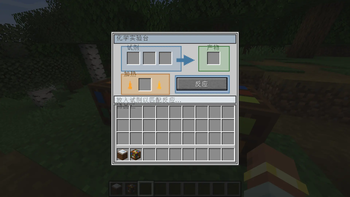
- Chemistry Table: Insert reagents, add an alcohol lamp when heating is required, then click React
- Elements & compounds: Covers common systems such as sodium, chlorine, sulfur, nitrogen, ammonia, iron, aluminum, carbon/silicon, and phosphorus
- Reaction feedback: Matching reactions show the corresponding chemical equation
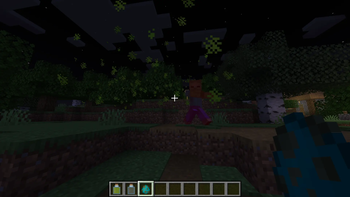
- Hazardous reagents: Toxic/corrosive reagents such as chlorine can be thrown; gases leave a lingering damage cloud (fiction only — do not imitate in real life)
- Chinese / English: Follows the game language automatically
How to play
- Open the High School Chemistry creative tab
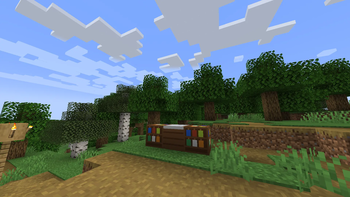
- Place a Chemistry Table
- Insert reactants (up to 3)
- For heated reactions, put an Alcohol Lamp in the heat slot (not consumed)
- Click React to obtain products
Notes (0.1.0)
- Some lab props (reagent shelf, beaker, etc.) are decorative placeholders for now; core gameplay is the Chemistry Table
- Content is inspired by common high-school chemistry topics; not an official textbook product, and unaffiliated with PEP / Mojang / Microsoft
- Still updating — feedback welcome
Installation
- Install Minecraft 1.20.1 and the matching Forge
- Put the mod jar into
.minecraft/mods - Launch the game
Do not handle or imitate dangerous chemicals in real life. This mod is for learning and entertainment only.
Галерея
Последние версии
Все версии →beta
High School Chemistry 0.3.0
0.3.011 окт. 2026 г.96Minecraft: 1.20.1, 1.20.2, 1.20.3, 1.20.4, 1.20.5, 1.20.6forge
Что нового
**High School Chemistry 0.3.0**
This version completes survival play. Every substance in the mod can be obtained yourself: gather the raw materials in the world, run the reactions on the chemistry bench, and follow the industrial steps on the matching machines. The chemistry book has 38 pages. It starts with gathering and equipment, then explains where each substance comes from, which machine to use, and the equation. Follow the pages and you can work through the whole mod.
Right-click the ocean or a beach with a glass bottle to collect seawater, right-click a river or lake for natural water, and right-click the air for an air sample. Evaporate seawater to get salt. Distill natural water to get distilled water. Coal, charcoal, sand, calcite, bones, leaves, raw iron, and clay are the starting materials for the routes that follow. The chemistry bench consumes reagents and gives products by the coefficients in the equation. The fluidized-bed furnace, electrolytic cell, grinding table, and cauldron follow the process, and each step yields one portion of product.
Added the electrolytic cell, fluidized-bed furnace, grinding table, and reagent shelf. Place redstone or a lever beside the electrolytic cell to supply direct current. It runs the electrolysis of brine, molten salt, and water. The fluidized-bed furnace is for roasting and calcining. Clay-to-aluminum, sulfur conversion, spodumene, and manganese ore all enter the process here. The grinding table grinds solids. Glass-bottle reagents can be placed on the reagent shelf, which labels each one as a pure substance or a mixture, and as an acid, base, salt, oxide, or another class.
Added a wall periodic table and a portable periodic table. Craft the portable one from a book and paper, and open it in your hand. Mount paper in item frames to hang the wall chart. It is six blocks wide and four blocks tall. Hold an element you have already made and use it on that element’s cell. Elements you have not made yet still show their symbols.
Added the breathing mask, crafted from iron and glass. In the high-school textbook, sodium peroxide turns carbon dioxide into oxygen in breathing masks and submarines. Wear the mask and go underwater. It consumes two sodium peroxide and gives two sodium carbonate, and restores a breath of oxygen.
Added seawater and natural-water sampling, and the full lithium, manganese, and zinc routes. Lithium runs from roasting, acidifying, and leaching spodumene through to lithium metal. Manganese starts from the manganese oxide that coal yields in the fluidized-bed furnace, then leaching, through to manganese metal and manganese dioxide. Zinc runs from leaching smithsonite through to zinc metal. Every step of these three routes is written in the chemistry book.
beta
High School Chemistry 0.2.0
0.2.025 сент. 2026 г.44Minecraft: 1.20.1, 1.20.2, 1.20.3, 1.20.4, 1.20.5, 1.20.6forge
Что нового
## Added
- Solutions: soluble reagents can be dissolved in distilled water at the chemistry table and are stored in reagent bottles
- Cauldron: right-click a cauldron with a solution (not a brewing stand). The liquid uses the vanilla water surface, colored as described in the textbook. Right-click with an empty hand to take it out
- Indicators: purple litmus, methyl orange, and phenolphthalein change the color of the liquid. pH paper changes the paper only; the solution stays the same
- Flame test: place an alcohol lamp, then right-click the flame with a lithium, sodium, potassium, calcium, or copper element, salt, or solution. Potassium needs blue cobalt glass in the other hand to show purple
## Flame colors
- Lithium: crimson
- Sodium: yellow
- Potassium: purple through blue cobalt glass
- Calcium: brick red
- Copper: green
## Updating
Replace 0.1.0 with this 0.2.0 jar. Do not keep both. Requires Minecraft 1.20.1 and Forge 47 or newer.
```
beta
High School Chemistry 0.1.0
0.1.03 авг. 2026 г.32Minecraft: 1.20.1, 1.20.2, 1.20.3, 1.20.4, 1.20.5, 1.20.6forge
Что нового
## 0.1.0 (Beta)
First public release of High School Chemistry.
### Added
- Chemistry Table: insert reagents and click **React** to run reactions
- Alcohol Lamp heat slot (required for heated reactions; not consumed)
- Common elements and compounds (sodium, chlorine, sulfur, nitrogen/ammonia, iron, aluminum, carbon/silicon, phosphorus, and more)
- Chemical equation feedback when a reaction matches
- Throwable hazardous reagents; gases can leave a lingering damage cloud
- Chinese / English localization (follows the game language)
### Notes
- Some lab props (reagent shelf, beaker, etc.) are placeholders for now; core gameplay is the Chemistry Table
- Content is still being expanded — feedback welcome