

Dirt RT
A path tracing shaderpack for vulkanite mod, better than demo pack
Автор: sjrsjz180,5 тыс.176обновлён 25 июл. 2026 г.
path-tracingpbrРеалистичные
Описание
A path tracing shaderpack for vulkanite mod, better than demo pack
Github: Dirt RT
Notice: YOU NEED TO LOAD A PBR RESOURSEPACK AND USE Vulkanite 26.2 branch TO MAKE THE SHADER WORK CORRECTLY
This shaderpack requires a high performance GPU (like RTX 4060/70) so that your card won't burn into ash
If you cannot launch the game due to a strange memory or stack overflow, try adding -Dorg.lwjgl.system.stackSize=1024 to your JVM options.
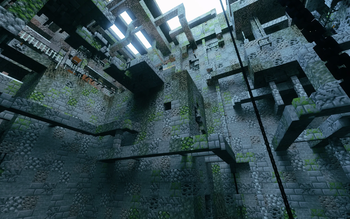
Галерея


Последние версии
Все версии →release
0.4.0
0.4.025 июл. 2026 г.30,1 тыс.Minecraft: 26.2fabric, iris
Что нового
### ⚠️ Requirements
- **Vulkanite mod(modified version)** ([26.2 branch](https://github.com/sjrsjz/vulkanite-modified/releases/tag/26.2-v0.0.5)). **DO NOT** use the original version
- **LabPBR resource pack** (required for correct material decoding)
- **RT-capable GPU**. For example, RTX 4060
- After reloading resource packs, **restart the game** to make the shader work properly.
---
## What's New
Almost everything has been rewritten since v0.3.0. Here's what you'll notice:
### Better Image Quality
- **Much less noise** — the new denoiser preserves sharp edges (block corners, stairs, fences) while aggressively smoothing flat surfaces like walls and floors. Rough surfaces like stone and gravel receive naturally stronger filtering than smooth surfaces like polished diorite.
- **Less ghosting** — camera movement no longer leaves trails behind. The new temporal clamping catches and discards stale history instead of blending it in.
- **Clearer reflections** — reflections on curved surfaces (cauldrons, anvils, water ripples) no longer smear when you move. Specular noise cleans up faster frame-to-frame.
- **Better water & glass** — transparent surfaces correctly trace through multiple layers. Looking through a glass pane into underwater caves now works properly.
- **No more crawling noise patterns** — the RNG no longer correlates across frames, so noise is truly random frame-to-frame instead of forming visible grid-like patterns.
### Path Guiding
Light now intelligently samples toward bright directions learned from previous frames. Dark corners converge faster because the shader stops wasting rays on directions that lead to shadow.
### End Sky
The End dimension now has a proper custom sky: a procedural nebula with glowing rune-ring structures. Toggle between this and atmospheric scattering in the shader settings.
### Filmic Bloom
Bloom is now smoother and faster by using Gaussian downsample & upsample
### New Tone Mapper
Replaced the old ACES tone mapper with TonyMcMapface — a tiny neural network trained for natural-looking HDR-to-SDR conversion. Colors are more balanced, with less color shifting in bright highlights.
### Auto Exposure
The shader now automatically adjusts exposure based on scene brightness. Walk from a dark cave into sunlight and your eyes will adapt naturally. Tune the paper-white luminance and exposure curve to your liking in settings.
### Performance
- **Higher FPS** across the board thanks to buffer unification, half-float packing, and compute shader optimizations
- **Lower VRAM usage** — all per-pixel data has been consolidated into 4 packed buffers
- **Parallax occlusion mapping only on first hit** — secondary bounces skip POM, saving significant RT cost
### Full Iris UI
All settings are now exposed through the Iris shader options panel — no config file editing needed. 39 sliders and toggles across 6 categories: Ray Tracing, Material, Exposure & Display, Bloom, Temporal Filter, and À-Trous Denoiser. Plus 22 debug views for screenshots and troubleshooting.
### Chinese Localization
Complete zh_cn translation of all UI text.
## Known issue
Refraction is still noisy
release
SVGF with Mahalanobis edge-stopping
v0.3.018 июн. 2026 г.7,4 тыс.Minecraft: 1.20.1iris
Что нового
# Feat: Groundbreaking denoiser — SG-based physical irradiance integration + SVGF with Mahalanobis edge-stopping
This is a landmark release that rewrites the entire denoising pipeline from the
ground up. The new denoiser produces dramatically cleaner, more stable, and
more physically accurate results than ALL previous versions combined.
## CORE INNOVATION: Spherical Gaussian (SG) Physical Irradiance Integration
The old SH (Spherical Harmonics) irradiance projection has been completely
replaced with a physically-based SG (Spherical Gaussian) integration framework:
• Dual-SG product convolution — light lobe × cosine lobe solved analytically
via SGProduct(), yielding exact attenuation without series truncation
• HSG (Hemispherical Spherical Gaussian) integral — closed-form integration
over the hemisphere using a rational approximation of the erf function
• NaN-safe math primitives throughout — precise_erf() with Abramowitz-Stegun
coefficients, expm1_over_x() with 1st-order Taylor fallback, and
safe_lambda_over_one_minus_exp_two_lambda() with cubic Taylor expansion
near the singular point λ → 0
• Numerically stable dual-SG product — sqrt_term clamped against negative
floating-point drift, axis normalization with ε-guard, log-space amplitude
accumulation to avoid overflow
This means every irradiance sample is now projected and reconstructed with
physically correct cosine-weighted integration, eliminating the ringing,
energy loss, and directional smearing that plagued the old SH pipeline.
## TEMPORAL ACCUMULATION: Unbiased Welford Variance Estimation
Previous versions used a biased exponential moving variance. The new pipeline
employs Welford's online algorithm — a numerically stable, UNBIASED estimator
that tracks both mean and variance in a single pass:
• True population variance (not EMA approximation) → spatial filter gets
accurate uncertainty estimates
• Per-pixel temporal weight based on geometric consistency (normal × depth
× position reprojection validation)
• Exponential moving average blending with adaptive history length —
faster convergence on new surfaces, longer accumulation on static ones
## SPATIAL FILTER: SVGF with Mahalanobis-Distance Edge-Stopping
The à-trous wavelet filter has been completely rewritten with a multi-
dimensional edge-stopping function that jointly considers:
• Normal similarity: pow(dot(n1, n2), NORMAL_POWER) — cosine-weighted
• Depth discontinuity: anisotropic kernel stretching along surfaces at
grazing angles, staying tight across depth edges
• Luminance-directional statistical distance: full Mahalanobis distance
combining SH-derived intrinsic variance (|dir|² vs Y²) with temporal
Monte Carlo variance → variance-guided adaptive stopping
6-level à-trous hierarchy: step 1→2→4→8→16→32 pixels, each with R0
tuned to the spatial scale. High-variance regions get aggressive filtering;
well-converged regions preserve fine detail. This is a night-and-day
difference from the old uniform blur.
## ADDITIONAL IMPROVEMENTS
• Neural network tone mapper (20 hidden neurons, 4→20→3 architecture with
sigmoid activations) — trained to approximate a high-quality photographic
tone curve, replacing the old hard-coded filmic curve
• Full HDR pipeline (hdr.glsl) — proper HDR→SDR conversion with luminance
adaptation
• Physically-based atmosphere scattering rewrite — Rayleigh/Mie with per-
dimension parameters (Overworld/Nether/End), sunlight brightness boosted
10× to match real-world solar irradiance ratios
• Importance sampling via Gaussian sphere function — faster convergence
with fewer fireflies
• Parallax Occlusion Mapping — geometric detail on flat surfaces
• GGX denominator epsilon guards — prevents NaN/Inf propagation in
specular BRDF evaluation
• Fixed a serious TAA reprojection bug, reduced VRAM usage
• Comprehensive technical documentation (main.pdf / main_en.pdf) covering
the full pipeline with mathematical derivations
---
RESULT: This is not an incremental improvement. The denoising quality jump
is categorical — clean indirect illumination that converges faster, preserves
geometric detail, and eliminates the noise bias that plagued every prior
version. The renderer is now fundamentally physically-grounded rather than
heuristic.
release
Dirt RT v0.2.0
v0.2.03 дек. 2024 г.99,6 тыс.Minecraft: 1.20.1, 1.20.2iris
Что нового
Fixed TAA bugs
Use **more efficient** algorithm (in doc/main_en.pdf) to create a better denoiser. Now the scene is more realistic!
Make atmosphere rendering more faster
Less noisy image
release
Dirt RT v0.1.5
v0.1.530 мая 2024 г.25,8 тыс.Minecraft: 1.20.1, 1.20.2iris
Что нового
better shadow
improved image quality
fixed many bugs
release
Dirt RT v0.1.4
0.1.426 мая 2024 г.904Minecraft: 1.20.1, 1.20.2iris
Что нового
fixed some bugs
**cleaner image**
release
Dirt RT v0.1.3
0.1.37 февр. 2024 г.9,9 тыс.Minecraft: 1.20.1, 1.20.2iris
Что нового
Fixed a **SEIROUS BUG** on NVIDIA driver version 551.23
Added more settings and improved some qualities
release
Dirt RT v0.1.2
0.1.228 янв. 2024 г.1,3 тыс.Minecraft: 1.20.1, 1.20.2iris
Что нового
Add clouds (ugly)
fixed some bugs and improved image detail
release
Dirt RT v0.1.1
0.1.114 янв. 2024 г.4 тыс.Minecraft: 1.20.1iris
Что нового
improved quality and fixed bugs
release
Dirt RT v0.1.0
0.1.011 янв. 2024 г.693Minecraft: 1.20.1iris
Что нового
Added weather support(rainy),improved image quality and different dimension has different atmosphere effects
release
Dirt RT v0.0.1
0.0.17 янв. 2024 г.836Minecraft: 1.20.1iris
Что нового
source code:[Dirt RT](https://github.com/sjrsjz/Dirt-RT)
required Vulkanite v0.0.4